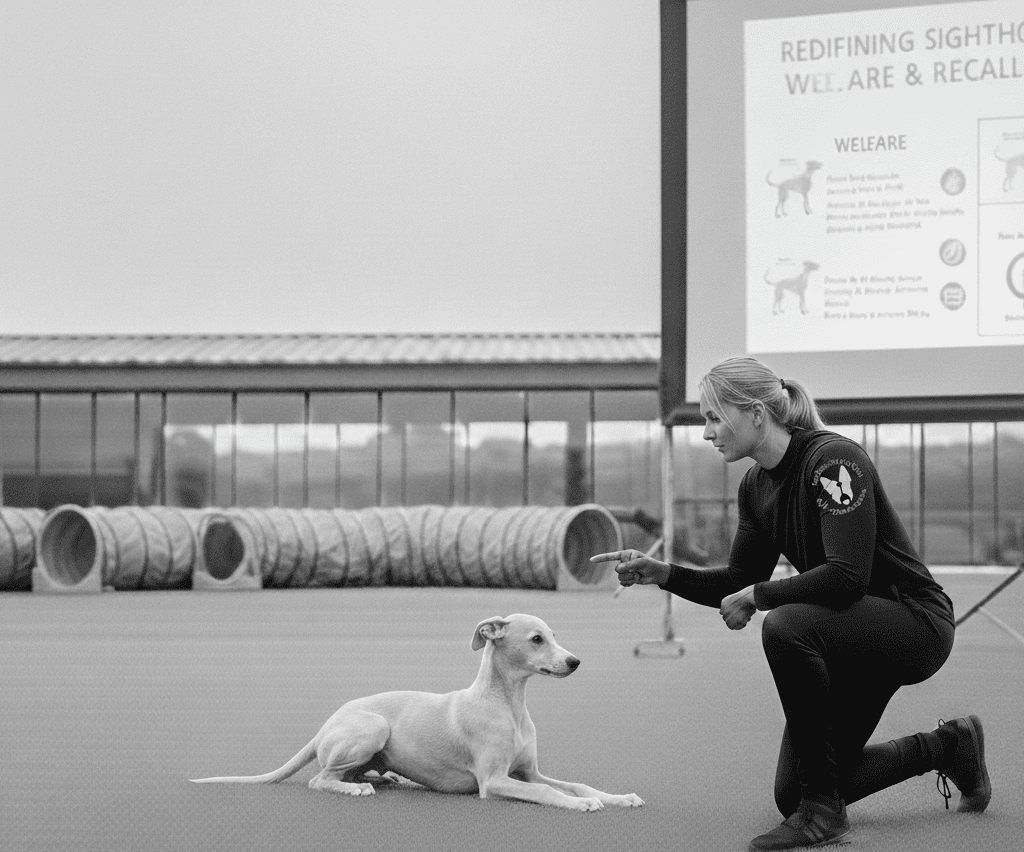
Module 11: Neurobiology, Physics & Ethics of Sighthounds
Focus: Understanding the biological and physical realities of high-prey-drive dogs.
This module challenges the conventional “long-line only” narrative and explores the ethics of sighthound management through the lenses of neurobiology, physics, and biological fulfillment.
1. The Neurobiology of “Prey-Lock”
Traditional training often relies on auditory (whistle/voice) or gustatory (treats) rewards. For a sighthound, these can become physically inaccessible due to their hardwiring.
- Temporary Deafness: When a sighthound “locks on” to movement, the brain undergoes an intense shift. The visual cortex takes over, effectively throttling the auditory processing centers.
- The Physical Barrier: It is not a choice to ignore you; it is a physiological inability to process your voice.
- The Trainer’s Shift: Stop viewing the dog as “disobedient” and start viewing them as “mentally unavailable.”
2. The Physics of the Long Line
We are often told that long lines are the “humane” alternative to off-leash training, but a professional look at the physics suggests otherwise.
| Variable | The Reality |
|---|---|
| Acceleration | A sighthound can hit 35mph in approximately three seconds. |
| Kinetic Energy |
Ek=12mv2
𝐸𝑘=12𝑚𝑣2 . As velocity increases, the energy involved in a sudden stop grows exponentially. |
| The Impact | On a 15-metre line, the dog reaches high velocity before the line runs out. The result is a skeletal jolt to the shoulders and spine. |
| The Risk | Acute soft tissue damage or chronic spinal misalignment. |

3. Tactile Stimulation as a “Circuit Breaker”
If sound and food cannot reach the brain during a prey-lock, we must find a communication channel that can.
- Tactile vs. Kinetic: A millisecond of low-level tactile stimulation (via a professional e-collar) acts as a physical “tap on the shoulder.”
- The Interruptor: The goal is to break the visual hyper-fixation before the dog reaches full speed, allowing the brain to switch back to a state where it can hear a command.
- Safety First: This is used as a preventative communication tool, not a punishment for running.
4. Ethical Discussion: The Definition of Welfare
We must ask uncomfortable questions about the quality of a sighthound’s life.
“Is a life spent entirely on a lead or confined to a small field ‘welfare,’ or is it biological deprivation?”
- The Argument for Freedom: Sighthounds are built for speed and expansive movement. Denying this expression can lead to secondary behavioral issues and a lack of fulfillment.
- The Modern Dilemma: Is the “Positive Only” label worth the physical risk of a long-line injury or the mental toll of permanent confinement?
Key Takeaways
- Acknowledge the Biology: Sighthounds enter a state of temporary deafness when triggered.
- Respect the Physics: Long lines can be more physically damaging than tactile corrections due to kinetic energy.
- Prioritise Fulfillment: True welfare involves finding safe ways to allow a dog to be what it was bred to be.
Exam
Use the information provided as a tool for deeper research to formulate your answers. To pass this course, students must achieve a minimum of 70%