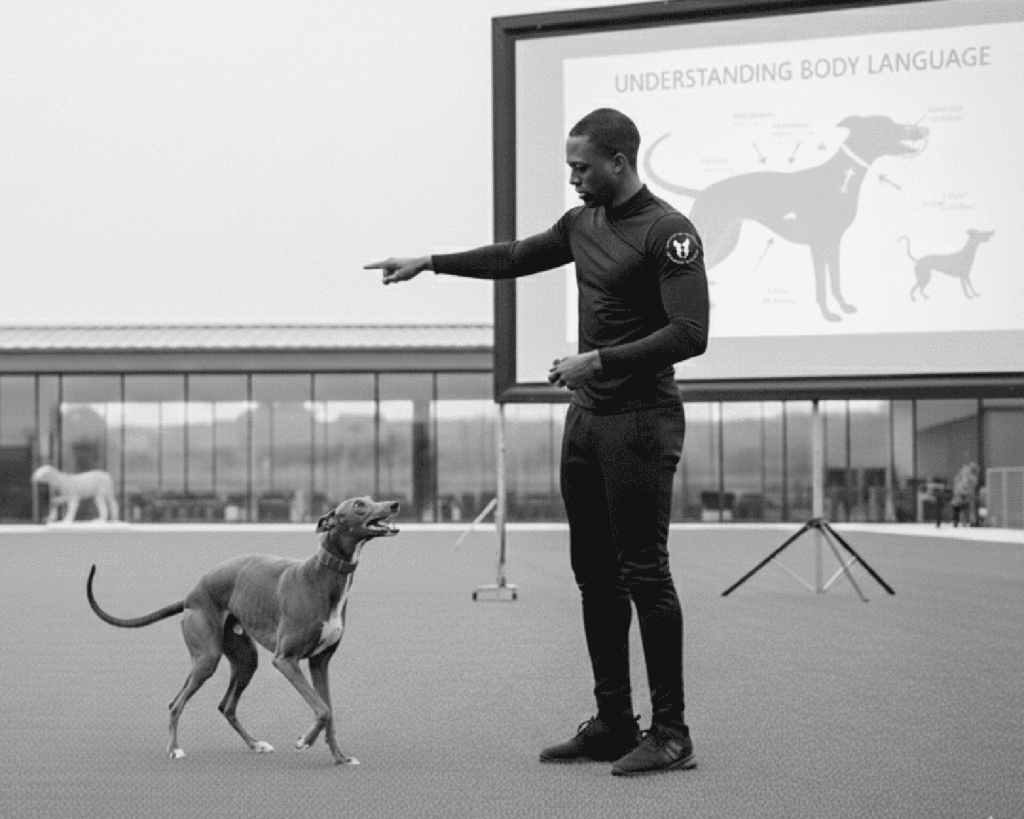
Module 2: Understanding Body Language
Dogs are masters of non-verbal communication, constantly conveying their emotions, intentions, and needs through a complex interplay of body signals. For dog owners, trainers, and anyone interacting with canines, learning to interpret this rich language is paramount. It’s the key to building stronger bonds, preventing misunderstandings, ensuring safety, and addressing behavioural issues effectively. Unlike humans, who rely heavily on verbal cues, dogs use their entire bodies from the tip of their nose to the flick of their tail to express themselves.
The Foundations of Canine Communication
Understanding dog body language isn’t about memorising a list of isolated gestures; it’s about interpreting a holistic picture. Dogs rarely use just one signal; instead, they combine multiple cues simultaneously. The context of the situation is also crucial. A tail wag might mean excitement in one scenario, but anxiety in another. Always consider the dog’s environment, recent events, and the other individuals (human or animal) present.
Key Body Parts and Their Signals
Each part of a dog’s body contributes to its overall message. Here’s a breakdown of what to look for:
The Tail
Often the first thing people notice, the tail is a highly expressive indicator, but its meaning is more nuanced than a simple wag.
- High and Stiff Tail: Can indicate arousal, alertness, or even a precursor to aggression. The higher the tail, the more confident or assertive the dog.
- Mid-level, Relaxed Wag: A loose, natural wag often signifies a comfortable, happy, or friendly dog. The speed and breadth of the wag matter.
- Low and Tucked Tail: A clear sign of fear, anxiety, or submission. The dog is trying to make itself appear smaller and less threatening.
- Broad, Sweeping Wag: Usually indicates extreme happiness and friendliness, often accompanied by wiggling hips.
- Small, Rapid Wag (especially high): Can indicate excitement, but also tension or uncertainty, particularly if the rest of the body is stiff.
The Ears
A dog’s ears, especially those that are naturally mobile, provide significant clues.
- Forward and Alert: The dog is paying attention, interested, or assessing something.
- Flattened Back (Pasted to Head): A strong sign of fear, anxiety, or submission. The dog is trying to protect itself.
- Relaxed/Neutral: Ears held naturally, often slightly to the side or forward, indicating a calm state.
- Swivelling: The dog is actively listening and trying to pinpoint sounds.
The Eyes
The eyes are often called the windows to the soul, and for dogs, they reveal a great deal about their emotional state.
- Soft Gaze/Squinting: Indicates relaxation, comfort, or affection.
- Hard Stare/Direct Eye Contact: Can be a challenge or a threat, especially if accompanied by a stiff body. Avoid direct prolonged eye contact with an unknown dog.
- “Whale Eye” (Half Moon Eye): When the whites of the eyes are visible, often at the inner or outer corners. This is a clear sign of stress, fear, or discomfort, indicating the dog feels threatened or is about to react.
- Dilated Pupils: Can indicate fear, excitement, or aggression, especially in low light.
- Rapid Blinking: Can be a sign of stress or an attempt to diffuse tension.
The Mouth and Lips
The mouth provides signals about a dog’s comfort level and potential for interaction.
- Relaxed, Slightly Open Mouth (Panting): A happy, comfortable dog, especially if the corners of the mouth are relaxed or slightly turned up.
- Closed Mouth, Tense Lips: Indicates stress, discomfort, or concentration.
- Lip Licking (without food present): A common calming signal indicating stress, anxiety, or an attempt to appease.
- Yawning (without being tired): Another common calming signal, often seen when a dog is stressed or trying to calm itself or others.
- Showing Teeth (without growling): A clear warning sign. This can range from a “submissive grin” (rare and context-dependent) to a full snarl indicating aggression.
- Growling: A vocal warning that should always be heeded. It’s a dog’s way of saying “I’m uncomfortable, back off.”
Overall Body Posture
The dog’s entire body conveys its general disposition.
- Relaxed Posture: Weight evenly distributed, soft muscle tone, often a loose, flowing movement.
- Tense/Stiff Posture: Weight shifted forward or back, rigid muscles, often a frozen or hesitant movement. This indicates high arousal, fear, or potential aggression.
- Low/Crouching: A sign of fear, submission, or an attempt to avoid confrontation. The dog is trying to make itself smaller.
- Raised Hackles (Piloerection): When the hair along the dog’s spine (shoulders, back, tail base) stands on end. This is an involuntary reaction (like goosebumps) indicating arousal, fear, excitement, or aggression. It does not always mean aggression, but it always means the dog is highly stimulated.
- Play Bow: Front legs extended, chest low to the ground, rear end up, often with a wagging tail. An invitation to play.
- Turning Away/Showing Side: An appeasement gesture, indicating the dog is not a threat and wants to avoid conflict.
Common Emotional States and Their Body Language Combinations
Dogs combine these individual signals to express complex emotions:
- Relaxed and Happy: Soft eyes, relaxed mouth, loose wagging tail (mid-level), relaxed body posture, even weight distribution.
- Fearful/Anxious: Tucked tail, flattened ears, “whale eye,” lip licking, yawning, trembling, low body posture, avoidance of eye contact, possibly panting or drooling.
- Excited/Playful: Wiggling body, broad sweeping tail wags, play bows, bouncy movements, open mouth with tongue slightly out.
- Aggressive (Warning/Offensive): Stiff body, direct hard stare, raised hackles, tail high and stiff (or stiff and low), growling, snarling, baring teeth, rigid stance. This is a clear “stay away” message.
- Submissive (Active): Crouching, rolling onto back (exposing belly), lip licking, averted gaze, tail tucked, sometimes urinating. This is an attempt to appease and show non-aggression.
- Submissive (Passive): Freezing, avoiding eye contact, often with a tucked tail and flattened ears. The dog is hoping to be ignored and for the threat to pass.
Misinterpretations and Nuances
It’s vital to avoid common misinterpretations. For example, a wagging tail does not always mean a friendly dog. A high, stiff, rapid wag can precede a bite, especially if the dog’s body is tense and its eyes are hard. Similarly, a dog that yawns or licks its lips when being petted might not be comfortable; these are often calming signals indicating stress. Breed differences also play a role. Breeds with naturally curled tails (like Pugs or Huskies) or cropped ears may have less obvious tail or ear signals, requiring handlers to pay even closer attention to other body cues.
Conclusion
Mastering dog body language is an ongoing journey of observation and learning. It requires patience, attention to detail, and a commitment to understanding the dog’s perspective. By diligently observing a dog’s tail, ears, eyes, mouth, and overall posture in various contexts, we can gain invaluable insights into their emotional state and intentions. This deeper understanding not only enhances our ability to train and care for them but also fosters a profound and respectful relationship, ensuring the well-being and safety of both humans and our beloved canine companions.